13th Two-Day International Conference(ICON 2026) at the School of Management Sciences Varanasi
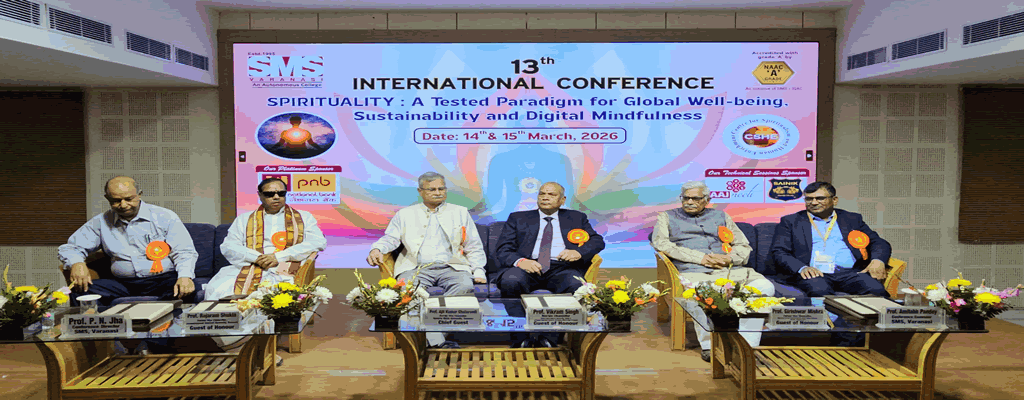
The 13th Two-Day International Conference commenced at the School of Management Sciences Varanasi. The central theme of the conference is “Spirituality: A Proven Paradigm for Global Well-being, Sustainability and Digital Mindfulness.” Addressing the inaugural session as Chief Guest, Ajit Kumar Chaturvedi, Vice-Chancellor of Banaras Hindu University, said that spirituality is not confined to any single tradition or religion but is a fundamental dimension of human life. He noted that such conferences provide an important platform for the younger generation to understand that spirituality is not merely a legacy of the past but also has deep relevance to modern science and contemporary society.
Referring to the ongoing global crises, Prof. Chaturvedi remarked that Indias balanced approach to development has become a source of inspiration for the world. Emphasizing the connection Between spirituality and global outlook, he said that genuine spiritual understanding emerges when individuals study and appreciate diverse cultures, traditions and religions. Restricting oneself to a single tradition narrows the scope of knowledge, whereas engagement with diverse perspectives reduces prejudice and opens new avenues for research. He expressed happiness that the School of Management Sciences Varanasi is actively working to integrate spirituality, inclusivity and ancient knowledge with modern technological progress.
Among the distinguished guests, Vikram Singh, Chancellor of Noida International University and former Director General of Police of Uttar Pradesh, urged young people to adopt discipline, balance and a spiritual outlook in life. He emphasized that proper use of time and dedication to ones goals are the keys to success. Highlighting the importance of wisdom and detachment, he remarked that a person of strong character alone can stand like an entire army. He also advised youth to stay away from misleading influences and utilize their time and resources wisely.
Another distinguished guest, Girishwar Mishra, former Vice-Chancellor of Mahatma Gandhi Antarrashtriya Hindi Vishwavidyalaya, Wardha, stated that the world today is becoming increasingly unstable and chaotic, making discussions on global well-being, sustainable development and digital awareness highly relevant. Referring to the ideas of Mahatma Gandhi, he said that Indian culture promotes values of love, coexistence and sensitivity and encourages people to view diversity as a source of strength.
Addressing the gathering, Rajaram Shukla, former Vice-Chancellor of Sampurnanand Sanskrit University, highlighted the depth of Indian traditions and their spiritual values. He stated that Indian culture represents a continuous flow of knowledge and compassion. Comparing the spread of knowledge to one lamp lighting another, he said that wisdom passed from teacher to disciple illuminates society. Referring to the epics Mahabharata and Ramayana, he noted that the life values described in these texts remain highly relevant even today in guiding society.
Welcoming the dignitaries, P. N. Jha, Director of the School of Management Sciences Varanasi, said that the institution is committed not only to academic excellence but also to fulfilling its social responsibilities. He added that such international conferences provide an important platform for intellectual exchange and for exploring new dimensions of research, thereby strengthening the integration of traditional Indian knowledge with modern global perspectives.
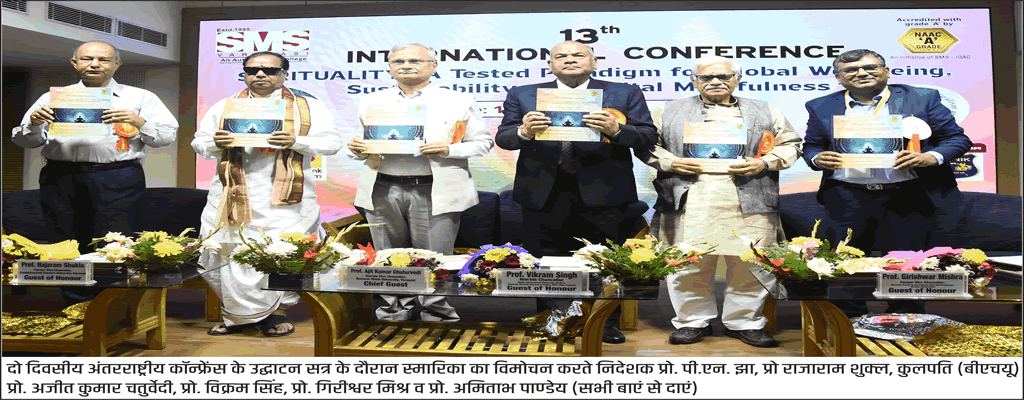
On the occasion, a conference souvenir based on the theme “Spirituality: A Proven Paradigm for Global Well-being, Sustainability and Digital Mindfulness” was released. A book based on the Twelfth International Conference held last year was also unveiled during the event.
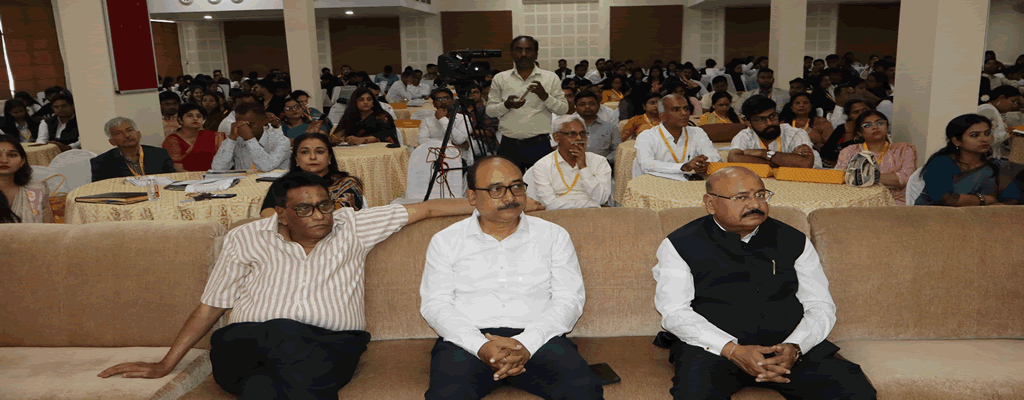
The inaugural session was moderated by Co-Convener Prof. Pallavi Pathak, while the vote of thanks was delivered by Conference Convener Prof. Amitabh Pandey. On the first day of the conference, several technical sessions were organized in which more than 300 participants from India and abroad presented their research papers.
The event was attended by Executive Secretary Dr. M. P. Singh, Director Prof. P. N. Jha, Registrar Mr. Sanjay Gupta, along with Prof. Sandeep Singh, Prof. Avinash Chandra Supkar, and faculty members and staff of the School of Management Sciences Varanasi.
Addressing the valedictory session as the Chief Guest, Bihari Lal Sharma, Vice-Chancellor of Sampurnanand Sanskrit University, Varanasi, said that spirituality lies at the very core of Indias soul.
It is not merely a philosophical concept but the fundamental basis of the countrys cultural consciousness and way of life. He noted that the significance of this land has also been mentioned in ancient scriptures. Citing the Vishnu Purana, he said that the region located north of the ocean and south of the Himalayas is known as Bharatvarsha, which represents not just a geographical territory but a sacred land where traditions of knowledge, spiritual practice and human welfare have flourished for centuries.
Prof. Sharma further explained that a person born on this sacred land carries a special responsibility. He elaborated that the word Bharat derives from “Bha,” meaning light, and “Rat,” meaning one who is devoted to it. Thus, a true Indian is one who remains devoted to knowledge, enlightenment and the pursuit of wisdom. Such individuals create and think not merely for personal benefit but for the welfare of the entire world. This is why India’s philosophical tradition has always upheld the ideal of “Sarve Bhavantu Sukhinah,” which seeks the happiness and well-being of all.
Referring to the Isha Upanishad, he stated that Indian sages proclaimed thousands of years ago that the divine resides in every particle of the universe. Modern science, by discovering that energy exists in every particle, has in many ways validated the wisdom of ancient knowledge traditions, sometimes referred to in modern terms as the “God Particle.” He observed that as science advances, the relevance and authenticity of ancient Indian scriptures will become even more evident. According to him, many of the mental stress and imbalance issues facing the modern world can find solutions in India’s knowledge traditions. He emphasized that while embracing modern knowledge and technological advancements, society must remain connected to its cultural roots. True development, he said, can be achieved only when spirituality and modernity exist in a balanced harmony.
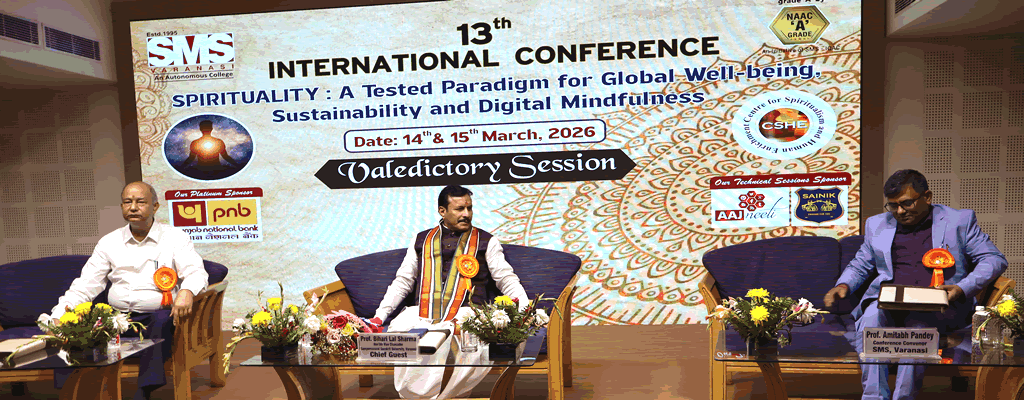
Welcoming the Chief Guest, P. N. Jha, Director of the School of Management Sciences Varanasi, highlighted the successful organization of the two-day conference. He stated that in an era where technological progress and digital expansion are reshaping human life, it is equally important to understand traditional knowledge and spiritual values and present them in contemporary contexts. He added that the Indian intellectual tradition has always been rooted in balance, coexistence and human welfare—values that can guide the global community today. On the second day of the conference, a plenary session was organized featuring spiritual researcher Sean Clark from Goa and Bodhi Shuddhananda Brahmachari, Founder of the Lok Nath Divine Life Mission, Dubai. In addition, fourteen technical sessions and five online sessions were conducted. Nearly 300 participants from Australia, Dubai, Canada, Oman, Bangladesh, Nepal and various parts of India presented their research papers.
The valedictory session was conducted by Co-Convener Prof. Pallavi Pathak, while the vote of thanks was delivered by Conference Coordinator Prof. Amitabh Pandey. A detailed report of the two-day international conference was presented by Prof. Avinash Chandra Supkar. The event was attended by Executive Secretary Dr. M. P. Singh, Director Prof. P. N. Jha, Registrar Mr. Sanjay Gupta, Prof. Sandeep Singh, along with faculty members and staff of the School of Management Sciences Varanasi.